
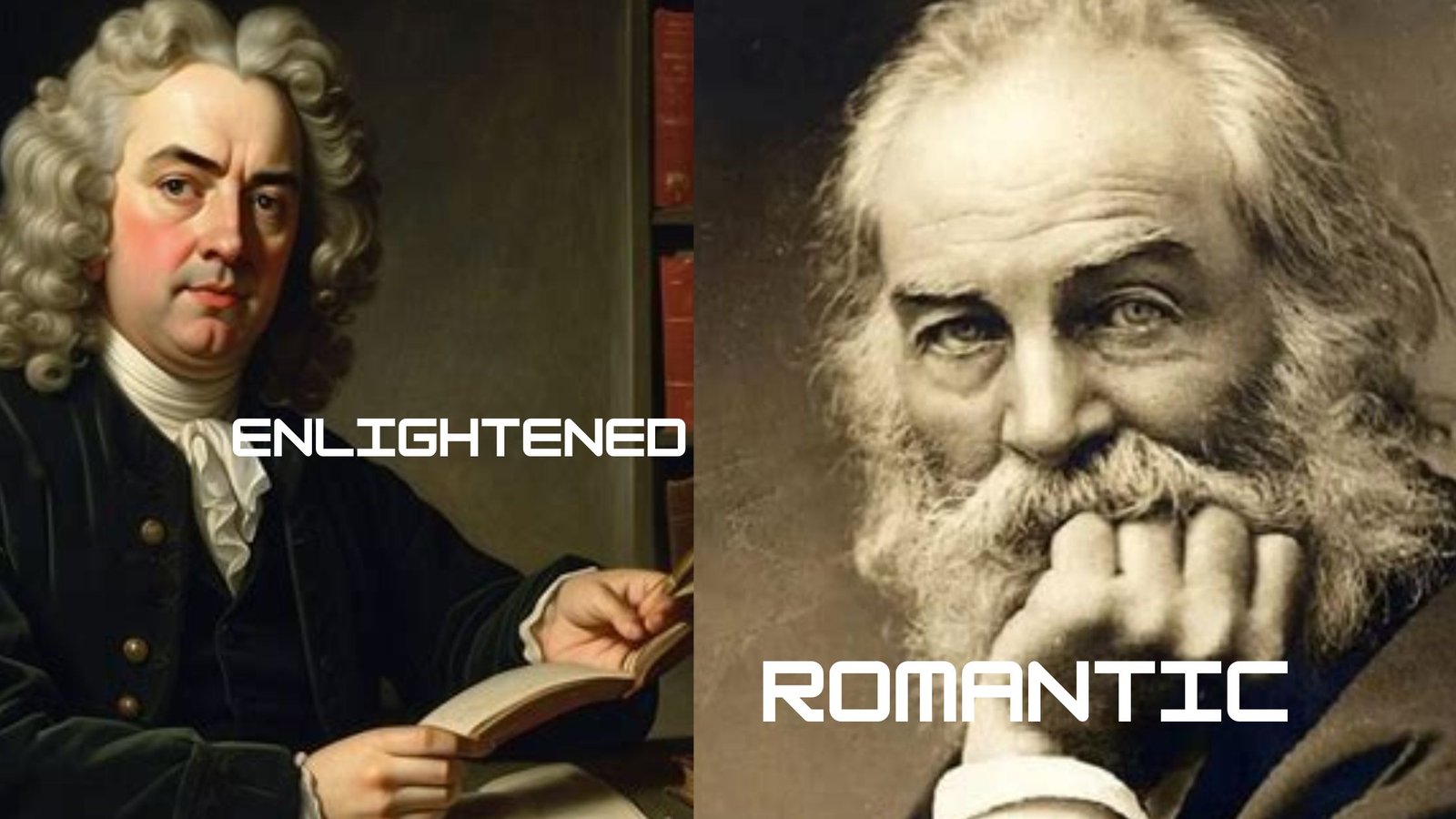
Characteristics of the Age of Enlightenment include an emphasis on reason, a control of passion, and an adherence to rules and laws. Romanticism emphasizes emotions, freedom, and fulfillment.
The aspects of the Age of Enlightenment are evident in the fourth part of Swift’s “Gulliver’s Travels,” a book that was a huge inspiration for my upcoming science fiction epic fantasy novel. The aspects of the Age of Romanticism can be illuminated through the work of Walt Whitman. By comparing the works of Whitman with Swift’s book, the differences between the two ages becomes clear.
The Fourth Part of Gulliver’s Travels and the Age of Enlightenment’s Prominent Themes
In “Gulliver’s Travels,” the aspects of the age of Enlightenment are personified by the equestrian creatures, the Houyhnhnms. Their society is based on reason, where no emotion overwhelms the senses, and there is a strict obedience to society’s rules
In opposition to the horses are the Yahoos, who are brutish men, representing a society without reason or order. The Yahoos, in contrast with the Houyhnhnms, represent the failure of society without reason, accentuating the value of reason, rules, and self-control.

Enlightened Characteristic: Reason and Virtue
Here we see the Houyhnhnms thoughts on civilized man: “That our institutions of Government and law were plainly owing to our gross defects in reason, and by consequence, in virtue; because reason alone is sufficient to govern a rational creature” (Swift). In this quote, we see the emphasis on reason. Through the diction, there is a strong connection established between the words “reason” and “virtue.” This connection shows how the book emphasizes elements of the Age of Enlightenment.
Here is another example: “My master continuing his discourse said there was nothing that rendered the Yahoos more odious, than their undistinguished appetite to devour everything that came in their way” (Swift). Here also see how the diction illuminates aspects of the Enlightened Age. The Yahoos are characterized by their inability to control one’s self and this is deemed “odious” by the horse-like intelligent species. By demonizing the inability to control themselves, this passage praises the opposite, which is a control of passion, and also an element of this Age.
Adherence to Rules and Laws in the Age of Enlightenment
Another characteristic of the Age of Enlightenment present in Swift’s novel is an emphasis on adhering to rules and laws. The intelligent equestrians are ruled by reason, and therefore, none exhibit any displays of rebellion.
Here we see the obedience to rules expressed by Gulliver, who respects the Houyhnhnms and wants to live among them: “I would attempt in obedience and gratitude to his honor, although I concluded the thing to be impossible” (Swift). Here the obedience to rules is so significant that even though the desired obedience is “impossible,” the character will still try.

This devotion to a rule accentuates the element of the Enlightened Age that is defined by adherence to rules. Gulliver, in his part of the narrative, is completely at the mercy of the horse species – specifically his “master.” Following the rules is imperative to his comfort and to his survival. In the following quote, we see this obedience in action: “I entreated him to let me bathe in a river that was near. He consented” (Swift). The phrase “to let me” reflects how Gulliver is subject to his master’s permission.
Song of Myself and the Age of Romanticism
From one of the greatest poetry books of all time, Walt Whitman’s “Song of Myself” strongly expresses elements of the Age of Romanticism, including an emphasis on emotion, a man’s freedom, and fulfillment of an individual. In part 21 of the poem, it is seen how nothing is left hidden from the evocation of emotion: “Smile O voluptuous cool-breathed Earth!” (Whitman).
The word smile has connotations of happiness and joy. Beckoning the emotion from the Earth itself demonstrates how Whitman’s poetry emphasizes emotion. Earlier in the same part of the poem, the poet observes the great range of human emotion by proclaiming “The pleasures of Heaven are with me and the pains of Hell are with me” (Whitman).

Commenting on the varieties of human feelings, he claims both are with him, and this emphasizes the importance of emotion clearly. The images of “Heaven” and “Hell” are not physical, reasonable places but metaphors constructed by the human spirit.
Romantic Characteristic: the Theme of Human Freedom
The theme of human freedom is also embodied in Whitman’s poem. At the beginning of part 51, he pronounces such: “The past and present wilt – I have filled them, emptied them/ And proceed to fill my next fold of the future” (Whitman).
Freedom can be seen in these lines through the speaker’s assumption of past, present, and future. There is apparently nothing holding him back from proceeding on to “fill my next fold of the future.” The voice is strong and secure, and there is nothing mentioned that limited his freedom in the past and present.

Individual Fulfillment in the Age of Romanticism
Another characteristic of Romanticism is a focus on the fulfillment of an individual, which Whitman asserts in the first lines of the first part of this poem, “I celebrate myself and sing myself/ And what I assume, you shall assume/ For every atom belonging to me as well belongs to you” (Whitman). Here is fulfillment of the individual, noted by the word, “myself.” The individual is celebration, belonging to the universe, and interconnected with every other body on the planet. The celebration of self is the epitome of the characteristic of Romanticism regarding one’s personal fulfillment.
Romanticism vs. Enlightenment
In “Gulliver’s Travels,” the characteristics of the Age of Enlightenment that are most apparent are:
- An emphasis on reason
- Control of passion
- Adherence to the rule of law
In “Song of Myself,” the characteristics of the Age of Romanticism that are evident include:
- An emphasis on emotion
- Personal freedom
- Individual Fulfillment
After examining the two works in contrast with each other, the similarities and differences between the two are exposed.
© Copyright 2026. All Rights Reserved.
Want more? Sign up for the Newsletter and read this next: The Themes of Faust by Goethe