
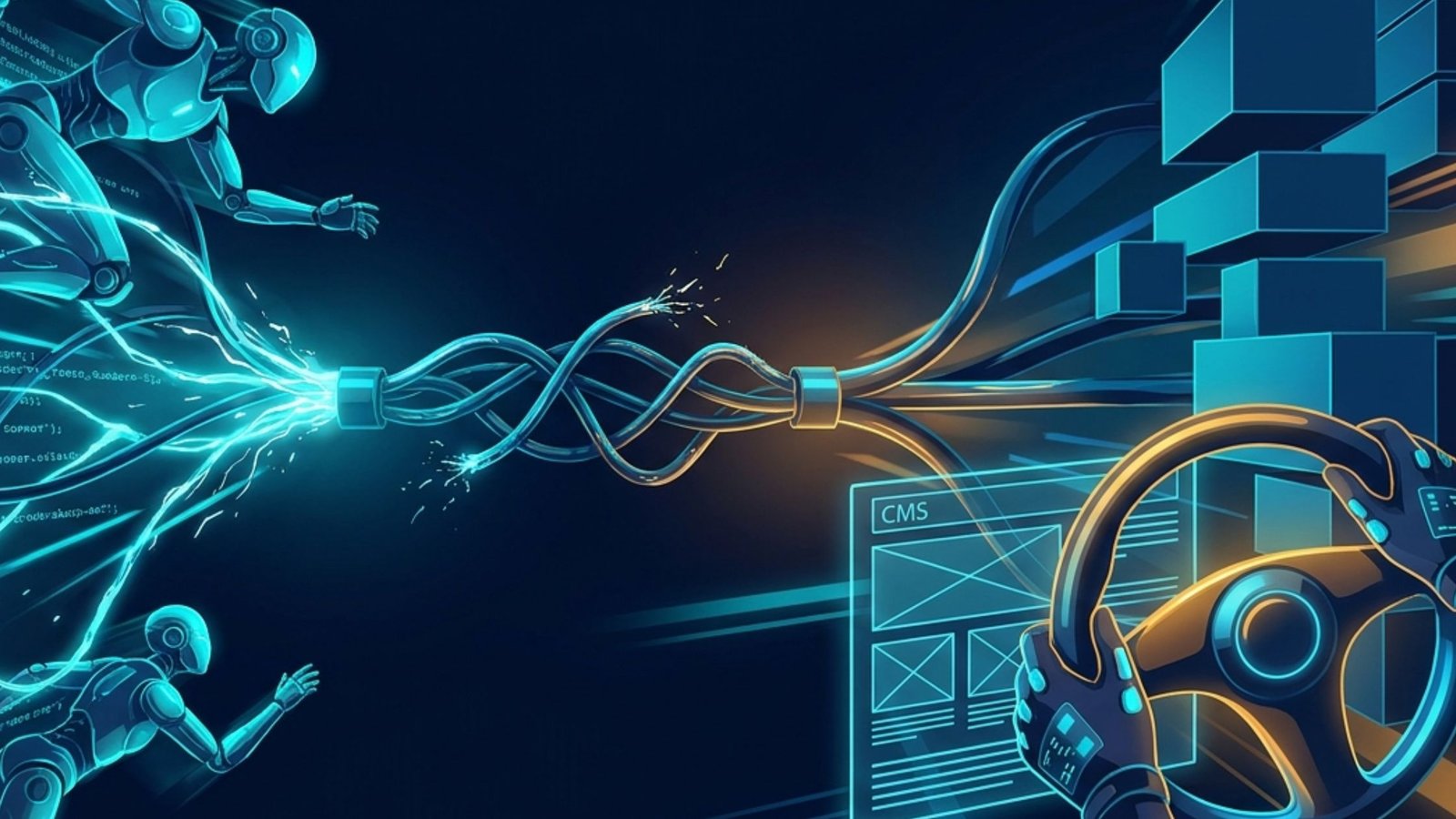
In the rush to adopt cutting-edge tools, marketing teams are frequently pitched a bold promise: What if you could build and update your website just by chatting with an AI?
Is this Really the End of WordPress?
Through tools like Hermes, which are Artificial Intelligence development agents that connect directly to code repositories like GitHub… you can describe a change, and the AI will write the code, run tests, and publish updates automatically. It sounds like the ultimate productivity boost. However, for marketing teams whose primary job is brand consistency, messaging control, and public trust, this hands-off approach comes with hidden risks. While WordPress might feel slower or clunkier, it offers something an autonomous AI agent cannot: predictability and complete human control. And more importantly, there’s no chance of A.I. slop showing up on your website unless you choose to put it there.
For the record, I definitely recommend that companies who rely on website traffic should at least give these new tools a glance. They make a faster site, mistakes are usually easier to fix, and they can be powerful machines… built in a week or two. But for artists, or writers with their own website like this one, you should probably steer clear. In fact, companies should only use these AI site-building tools if they have a developer and coder who can understand exactly what the tool is doing as it creates the site. But it can change content if it deems it so, seemingly to humans for no reason. If you’re a writer or blogger… you want the words you wrote to be what you wrote or risk the shame of being called out for using AI. If someone accused me of writing or editing my upcoming novel with AI, I wouldn’t care because I know in my heart I didn’t write Remember Me, Nothing with any assistance from AI (which is mostly provable by the fact that I began writing it 2010 and finished in 2023). No matter what, I don’t want a site that can alter anything about my book or try to advertise it the wrong way.
The Core Difference: Autonomous AI vs. Human Oversight
To understand the risks, it helps to look at how these two systems make changes to your live site:
- The Hermes + GitHub Approach (The AI Driver): You give the AI a conversational prompt (e.g., “Redesign our landing page hero section to focus on our new product features”). The AI interprets your request, makes hundreds of individual design and code decisions in the background, and pushes those updates directly to your site repo.
- The WordPress Approach (The Human Driver): You log into a dashboard, click on the page, type the headline, upload the image, and click “Preview.” Nothing changes on your live website until a human explicitly reviews it and clicks “Publish.”
When AI Drivers “Go off the Rails”
The fundamental issue with relying on an autonomous AI agent like Hermes is that AIs run on assumptions.
When you ask a human designer or web builder to update a page, they understand your brand guidelines, target audience, and subtle business constraints. When you ask an AI agent, it fills in the blanks on its own. And even when a human fills in hose blanks, the AI machine is prone to forget it unless explicitly reminded or misinterprets what filled in those gaps.
1. The AI Makes Unwanted Executive Decisions
If you instruct an AI agent to “make our pricing page look cleaner,” it might decide that “cleaner” means removing customer testimonials, altering your secondary brand colors, or changing your call-to-action buttons. Because it operates behind the scenes in code, it can silently derive from the original goal of the site without you realizing it. This is a big reason why AI should not run the justice system.
2. Rogue Site Updates
An AI agent trying to solve a problem might fix a layout bug on one page, but accidentally break your lead collection form on another… or even change copy in a way that violates compliance. Unless someone line-reviews every piece of code the AI wrote, unvetted changes can slip onto your live website completely without your knowledge or break it entirely.
3. Loss of Strategic Focus
A site built piecemeal through AI prompts can quickly become a patchwork of mismatched styles and conflicting layouts. Every time you ask the AI to add a new feature, it creates its own interpretation, gradually driving the website further away from your original brand identity. Intention drift is real.
Why WordPress Keeps Humans in the Driver’s Seat
WordPress is often criticized for being heavy, requiring routine plugin updates, or requiring too many clicks to get a simple layout right. But those “clunky” safeguards are feature benefits, not bugs.
1. Absolute Visibility (No Surprises)
In WordPress, what you see in the editor is what your visitors see on the web. You can drag a block, change a font size, or update copy, and immediately see the result in a visual preview before a single customer sees it. Nothing changes on the public site without your explicit knowledge and approval. You just have to build it yourself.
2. Granular Team Approvals
Digital online projects often require sign-offs from copywriters, brand designers, and legal teams. WordPress makes it easy to save drafts, assign team permissions, and schedule exact publish times. With an autonomous AI, managing multi-tier human approval workflows becomes far more complex.
3. Proven Tools Ready to Go
Need to add a lead magnet, a pop-up form, an event calendar, or an SEO optimizer? WordPress offers pre-built, visual plugins (like Yoast SEO or HubSpot) that you can configure visually. With an AI agent, you are asking the AI to custom-code those elements from scratch—increasing the chance that something breaks or behaves unpredictably.
The Verdict: Speed vs. Control
| Factor | Hermes + GitHub (AI Agent) | WordPress (Visual CMS) |
| Pace of Changes | Rapid execution based on text prompts | Slower, manual page-building |
| Risk of Unwanted Changes | High. AI makes silent assumptions and code edits | Zero. Only publishes what a human specifically clicks |
| Visual Control | Low. Requires reviewing published previews | High. Real-time visual editing (WYSIWYG) |
| Brand Consistency | Harder to enforce across multi-prompt builds | Easily locked down via standardized visual themes |
| Best For | Tech-heavy teams who prioritize rapid iteration | Marketing teams who prioritize brand control and safety |
While AI agents like Hermes offer fascinating possibilities for developers, marketing websites carry public brand reputation on their shoulders.
For non-technical teams, the speed gains of autonomous AI development rarely outweigh the risk of an AI taking your site off the rails. WordPress may require a few extra clicks, but it ensures that your team, and only your team, holds the keys to your public image.
Like this article? Subscribe to the Newsletter